
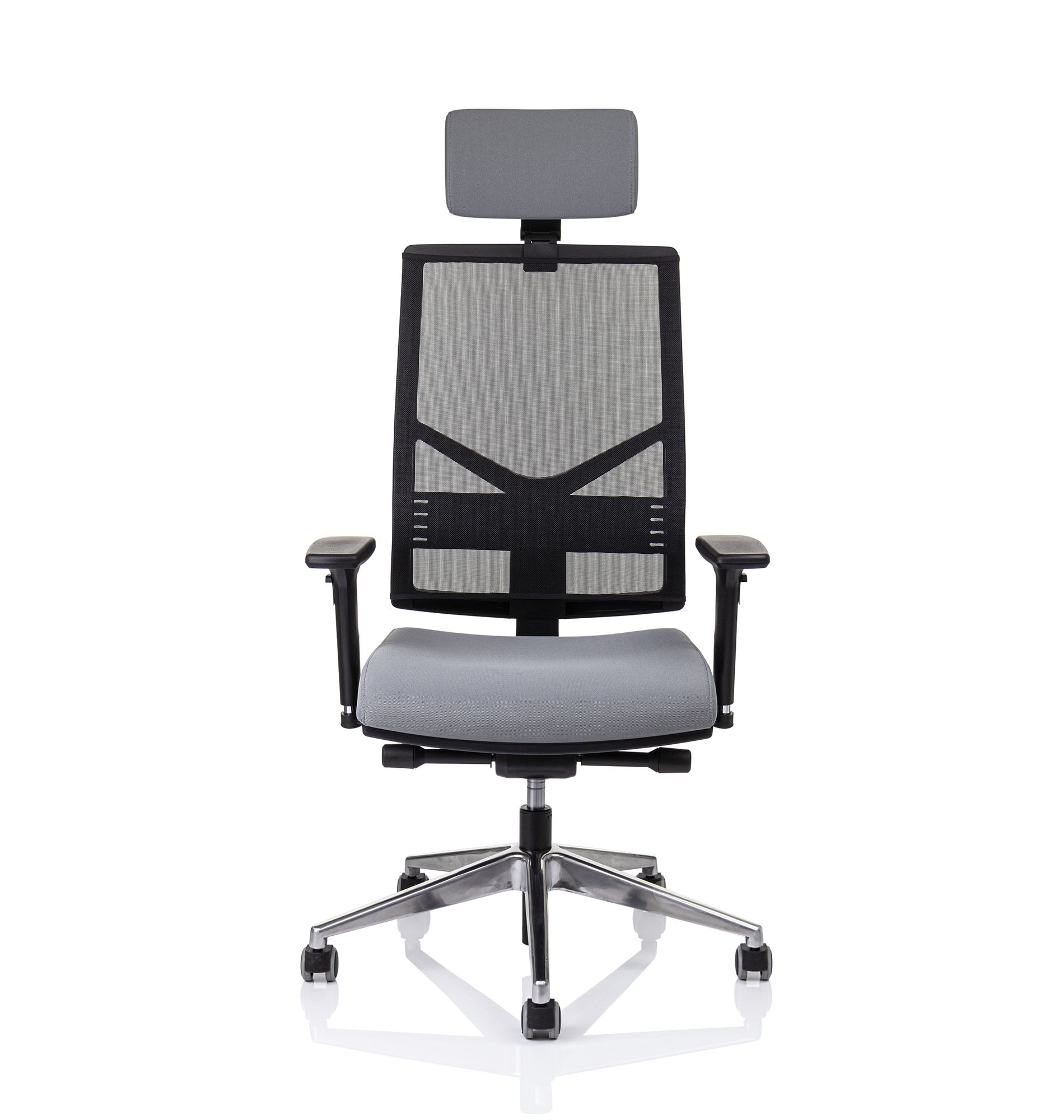
The question of how to choose an office chair only becomes serious when you sit at your desk for six, eight or more hours a day. The wrong chair does not break all at once; it slowly tires you, forces you into poor posture and, after a few months, leads to tension in the neck, shoulders and lower back. A good ergonomic chair, on the other hand, supports good posture, relieves the spine and lets you focus on your work instead of on discomfort. In this guide we go through everything that genuinely affects your choice: height adjustability, lumbar support, the synchronous mechanism, armrests, choosing between a mesh and an upholstered backrest, materials, warranty, and how to measure the right size for your body.
Adjustability: why a single type of chair is not enough
An ergonomic chair is not one product for everyone, but a tool you adapt to your body and your task. The more quality adjustments a chair has, the better you can align it with your desk, monitor and keyboard. When choosing, check whether the adjustments are actually useful in everyday work and not just on paper.
Four adjustments are the foundation of any serious chair: seat height, seat depth (or forward-and-back seat slide), lumbar support height and armrest adjustability. Without these four you will always be looking for a compromise. If you often switch positions between focused work and relaxed thinking, the option to recline the backrest with several locking positions is also welcome.
You will find the widest selection of chairs with different levels of adjustability in our office ergonomic chairs collection, where there is a suitable configuration for every budget and type of work.
The correct seat height and feet flat on the floor
Seat height is the first adjustment you make and the most common mistake. The rule is simple: your feet should rest flat on the floor, your knees should be at an angle of roughly 90 to 100 degrees, and your thighs should be parallel to the floor or tilted slightly downward. When the height is right, your body does not hang on the chair; instead, your weight rests evenly on the seat.
The gas spring (gas lift) determines the range within which you can raise or lower the chair. When choosing, check whether the declared range suits your body height and desk height. If the desk is fixed and too high, consider combining it with active ergonomic chairs or with a height-adjustable desk that lets you work standing and sitting and relieves static load.
Lumbar support: the heart of ergonomics
In the lumbar region the spine naturally forms a slight inward curve (lordosis). When we sit without support, this curve flattens or even reverses outward, which puts additional load on the intervertebral discs. Good lumbar support maintains this curve and helps preserve a neutral posture, which relieves the lower back.
When choosing, make sure the lumbar support is height-adjustable, because the point where you need support differs from person to person. Even better are supports that are also adjustable in depth (pressure firmness). If you often struggle with lower-back pain, our separate guide on how a chair should work for a loaded spine will be useful: the best office chair for back pain.
The synchronous mechanism: why it pays off
The mechanism is the assembly that connects the seat and the backrest and determines how the chair responds when you lean back. The differences between mechanism types are large and often have the greatest impact on both price and long-term comfort.
- Fixed mechanism (permanent contact): the backrest reclines on its own while the seat stays in place. A basic design, suitable for shorter periods of sitting.
- Synchronous mechanism: the backrest and seat recline in coordination at a ratio of roughly 2:1 or 3:1, so the body stays in a natural position and the feet do not slide off the floor. This encourages movement while sitting and relieves the spine.
- Mechanism with adjustable counter-tension: you adjust the recline tension to your body weight, which is key to making the chair respond just right for you.
For everyday work we recommend at least a synchronous mechanism with adjustable counter-tension and at least one recline lock. This is the setting that, in the long run, has the greatest effect on how much less tired you will feel at the end of the day.
Armrests: 2D, 3D or 4D
Armrests relieve the shoulders and neck, but only if they are adjusted correctly. The goal is for the forearms to rest relaxed while the shoulders stay lowered. Levels of adjustability are usually marked by the number of directions (D = dimensions):
- 2D: adjustable height and width (spacing).
- 3D: additionally adjustable depth (forward-and-back).
- 4D: additionally, the pad can be pivoted inward or outward.
For work with a keyboard and mouse, 3D or 4D armrests are noticeably more comfortable, because you actually support the forearms in the working position. If you work in executive roles and are looking for larger, upholstered seats, also take a look at executive chairs, where the armrests are usually more padded.
Mesh or upholstered backrest
A common dilemma is the choice between a mesh and an upholstered (foam, textile) backrest. Both solutions are good; the choice depends on the environment and personal preference. The comparison below sums up the essential differences.
| Property | Mesh backrest | Upholstered backrest |
|---|---|---|
| Ventilation | Excellent, air passes through the fabric | Lower, the back can get warmer |
| Feel of support | Taut, springy support that adapts to the body | Softer, "warm" feel, full contact |
| Suitability for hot rooms | Very suitable (summer, poorly ventilated spaces) | Better for cooler rooms |
| Maintenance | Easy, does not hold dust | Occasional deep cleaning of the fabric |
| Appearance | Technical, modern | Warmer, classic office look |
A general guideline: if you get warm quickly or work in a warm room, choose a mesh backrest; if you value a softer, full contact and a warmer look, choose an upholstered one. In both cases the quality of the lumbar support matters more than the type of material itself.
Materials, load capacity and warranty
A chair's durability lies in details you cannot see in a photo. When choosing, check the following:
- Seat fabric: abrasion resistance (usually expressed in Martindale cycles) tells you how much wear the fabric can withstand. A higher value means a longer service life.
- Seat foam: quality foam padding keeps its shape and does not sag after a few months. Cold-molded foam materials are generally more durable.
- Base: reinforced nylon or aluminium is more durable than ordinary plastic, especially for heavier users.
- Casters: choose casters suited to your floor (soft for hard floors, hard for carpets).
- Load capacity: standard chairs are mostly designed for around 110 to 120 kg. For greater body weight, choose purpose-reinforced models.
If you need a chair with a higher load capacity and a reinforced construction, take a look at the heavy-duty chairs collection. With the warranty, do not look only at the number of years, but also at what the warranty covers: the mechanism, the gas spring and the construction. Heka chairs come with a 3-year warranty and are made in our own production in Slovenia, which means shorter lead times for spare parts and repairs.
How to measure the right chair size
The size of the chair must suit your body, otherwise even the best adjustments will not help. Take two simple measurements in a correct sitting posture (feet on the floor, back against the backrest).
| Measurement | How to measure | What it determines |
|---|---|---|
| Seat depth | From the buttocks to the back of the knees, then subtract 5–8 cm | That you have 2–3 fingers of space behind the knees, not pressure |
| Seat width | Hip width in a seated position + a few cm of margin | That the hips rest comfortably on the seat |
| Seat height | Distance from the floor to the bend of the knee (seated) | That the feet rest flat on the floor |
If you are taller than about 185 cm or shorter than about 160 cm, pay particular attention to the gas spring range and to the seat depth adjustment option. For the correct setup of your entire workstation (monitor, keyboard, eye distance), also read the guide how to sit correctly at a computer.
How much does a good office chair cost
Prices vary depending on the mechanism, materials and level of adjustability. As a rough guide: solid entry-level ergonomic chairs start at around 150 EUR, chairs with a synchronous mechanism and adjustable lumbar support are usually available from around 250 EUR upward, while top models with 4D armrests and advanced mechanisms reach higher price ranges. With this investment it is worth counting on several years of use, so a quality mechanism and a good warranty generally pay off. If you are wondering how an ergonomic chair differs from an ordinary one at all, read the comparison ergonomic vs ordinary office chair.
Frequently asked questions
Which adjustment on a chair is the most important?
The most important is the correct seat height, as it determines the position of the feet, knees and, consequently, the entire spine. Right after it come the adjustable lumbar support and the recline mechanism, which together maintain a neutral posture.
Is a mesh or an upholstered backrest better?
Neither is universally better. A mesh backrest ventilates better and is suitable for a warm room, while an upholstered one offers softer, fuller contact and a warmer look. More important than the material is the quality of the lumbar support.
How do I know if a chair is the right size for me?
When you sit fully back against the backrest, two to three fingers of space should remain between the edge of the seat and the back of the knees, your feet should rest on the floor and your forearms should rest relaxed on the armrests. If any of this is not the case, adjust the settings or choose a different size.
What load capacity do I need?
Standard chairs are mostly designed for around 110 to 120 kg. If you exceed this range or want greater durability, choose a purpose-reinforced model from the heavy-duty chairs collection.
Is it worth buying a more expensive ergonomic chair?
If you sit for several hours a day, the additional investment in a better mechanism, quality materials and adjustability generally pays off through a longer service life and greater comfort. A chair is an investment for several years of use.
Can I try the chair before buying?
Yes. At Heka we offer a 7-day free trial, so you can adjust the chair correctly and test it at your leisure at your own workstation before making a final decision.
Take the next step
The best way to find out whether a chair really suits you is to try it in your own working environment. Choose a model from the office ergonomic chairs collection and take advantage of our 7-day free trial. We deliver the chair to you, you try it for a week at home or in the office, and only then do you decide. All Heka chairs are made in Slovenia and include a 3-year warranty.



Share:
How to Choose a Standing Desk: A 2026 Buying Guide