
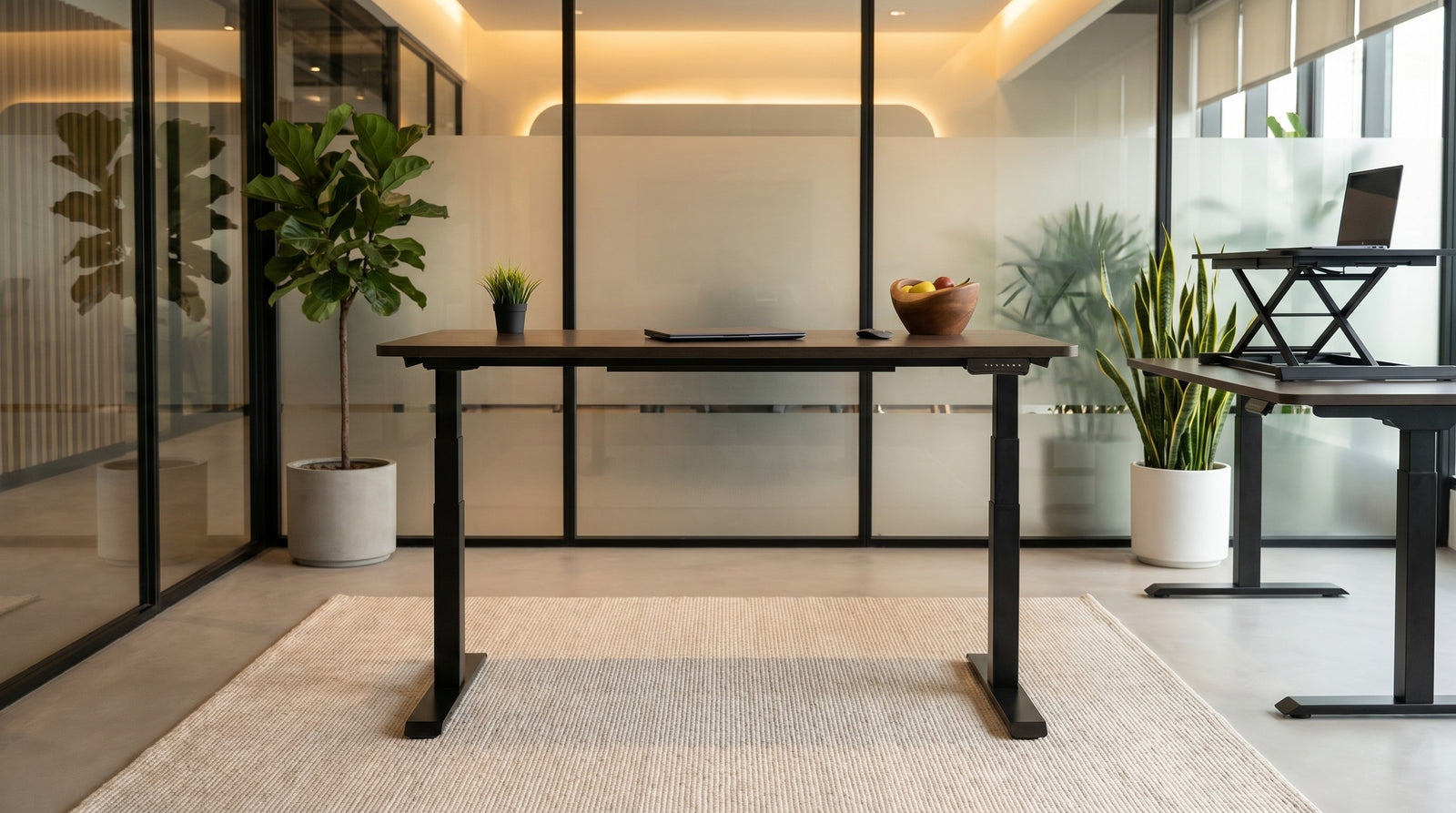
Sustainable office furniture is equipment with the smallest possible environmental footprint across its entire lifespan: from the origin of materials and production to use, repair and disposal. For companies it pays off for three reasons at once: a lower total cost of ownership, support for ESG goals and a stronger position in public tenders, where sustainability criteria increasingly earn additional points. In the following we explain what sustainability actually means, how to verify it with a supplier and how to build it into the procurement process.
What sustainable office furniture actually means
Sustainability is not a single feature but the sum of many decisions. Furniture is not "green" because it is marketed that way, but because it lasts a long time, generates little waste and can be repaired rather than replaced. When assessing it, pay attention to the following dimensions:
- Materials and origin: high-quality, traceable materials of known provenance; wood from responsibly managed sources, metal frames with a high recycled content.
- Local production: shorter supply chains mean a smaller transport footprint and fewer intermediaries.
- Long lifespan and repairability: robust construction and the availability of spare parts, so the furniture serves for 10 years or more.
- Modularity: components that can be upgraded, rearranged or replaced individually.
- Recyclability: separable materials at the end of the lifespan (metal, wood, textile).
- Certificates as a criterion: documented material and production standards that you verify with the supplier.
The most important message: the most sustainable furniture is the furniture you do not have to buy twice. A piece that lasts a decade and can be repaired is almost always a better environmental choice than a cheaper piece you replace after three years. When evaluating, therefore, do not look at a single feature but at the whole picture: high-quality wood from an unverified source, or a certified piece that loosens after two years, is not sustainable. Sustainability only shows itself in practice, in everyday use over the years.
Materials and origin: what to watch for
Material is the first point where sustainability is decided. Office furniture is dominated by wood or wood-based panels, metal and textile. For each of these, ask about the origin and the content of recycled raw materials.
- Wood-based panels: ask about the provenance and the formaldehyde emissions (the lower the value, the better for office air quality).
- Metal frames: steel and aluminium are highly recyclable; a durable surface finish that extends the lifespan is important.
- Textile and upholstery: resilient fabrics with high abrasion resistance withstand many years of intensive use; some manufacturers also offer fabrics made from recycled fibres.
With certificates, be specific but also cautious. Standards such as environmental labels for materials and production processes are a sensible criterion for comparing offers. However, check exactly what the certificate refers to (the material, the product or the process) and request supporting evidence. The best approach in procurement is simple: ask the supplier about the origin of the materials and the available certificates and include this information in your comparison of offers.
Why sustainable furniture pays off
Sustainability is not just an ethical decision but a financially sensible one. For a procurement department, four levers are decisive:
- TCO, or total cost of ownership: the higher initial price of a quality piece often pays for itself, because premature replacements, repairs by external contractors and disposal costs fall away.
- ESG goals: sustainable procurement is a measurable contribution to a company's environmental and social goals, which you can document in reports.
- Public tenders: environmental criteria increasingly earn additional points or are even a condition for participation; a documented sustainability profile for the furniture improves your position.
- Reputation and employee satisfaction: a well-kept, high-quality office is part of the employer brand and signals the company's values to partners and candidates.
In public procurement it is important that, alongside the offer, you also have supporting documentation about the materials and sustainability characteristics ready. A good supplier prepares this for you, without you having to search across multiple sources. Sustainability is at the same time an opportunity for brand consistency: if a company communicates environmental responsibility outwardly, this must also be reflected in its interior furnishings. The office seen by employees, clients and candidates every day is one of the most tangible proofs that values are not just on paper.
TCO: why the lowest price is not the cheapest
In sustainable procurement it pays to look at the cost per year of use, not just the purchase price. The comparison below illustrates the logic (the values are illustrative and depend on the specific product):
| Aspect | Cheaper choice | Sustainable choice |
|---|---|---|
| Purchase price | Lower | Higher |
| Expected lifespan | 3-5 years | 10 years or more |
| Availability of spare parts | Often not | Yes |
| Repairability | Limited | High |
| Frequency of replacement | More frequent | Rare |
| Cost per year of use | Often higher | Often lower |
For a chair an employee uses every working day, the difference in durability quickly becomes visible. We therefore recommend that, when comparing offers, you record not only the price but also the warranty, the availability of spare parts and the option to repair.
Checklist for sustainable procurement
To make the choice systematic, use the checklist below for every offer. The more answers are affirmative, the more sustainable the choice.
| Criterion | What to check | Importance |
|---|---|---|
| Origin of materials | Provenance of wood, metal, textile; recycled content | High |
| Local production | Where the product is actually made | High |
| Certificates | What they refer to, supporting evidence | Medium |
| Warranty | Length and scope | High |
| Spare parts | Availability and delivery time | High |
| Repairability | Whether individual parts can be replaced | High |
| Made-to-measure option | Less waste, longer usability | Medium |
| Delivery and assembly | In-house service or intermediaries | Medium |
You can also include this list in the tender documentation as criteria for evaluating offers. In this way sustainability becomes measurable and comparable across suppliers.
The role of made-to-measure and local production
Two levers have a disproportionately large effect in sustainable furnishing: made-to-measure and local production.
Made-to-measure means the furniture fits the space the first time around. There is less improvisation, fewer unused pieces and less waste. Furniture that fits the floor plan and work processes stays in use longer, because there is no need to supplement or replace it at the first change.
Local production shortens the supply chain. Shorter distances mean a smaller transport footprint, a faster response time for spare parts and repairs, and fewer intermediaries. When production is nearby, the service is nearby too, which directly extends the equipment's lifespan. Beyond the environmental aspect, a local supplier also has practical advantages: easier communication, viewing samples, adjustments during the project and reliable delivery without cross-border complications. This is especially important on larger projects, where the equipment has to arrive in a coordinated manner and within the agreed deadlines. Read more about this approach in the guide made-to-measure office furniture.
How Heka and Hit Preless support sustainable furnishing
Heka Interior is a brand of the company Hit Preless from Medvode, Slovenia, with more than 40 years of experience in its own furniture production. In sustainable furnishing we rely on concrete, verifiable advantages, not on promises:
- Local Slovenian production: manufacturing in Medvode means shorter supply chains and a lower transport footprint.
- Made-to-measure: we adapt the furniture to your space, which reduces waste and extends usability.
- Long lifespan and a 3-year warranty: robust construction with available spare parts means fewer replacements.
- In-house service: repairs and the supply of replacement parts run through us, not through a chain of intermediaries.
- Transparent documentation: for procurement and tenders we prepare the information about materials that you need for your decision.
When selecting equipment, start with the most frequently used pieces. For seating, ergonomic office chairs (from approx. EUR 200) will help you, and for a healthy alternation between sitting and standing, sit-stand desks. You will find the full overview in the office furniture category. When designing the whole space, the guides how to furnish an office and ergonomics in the workplace will help you.
Frequently asked questions
What is sustainable office furniture?
Sustainable office furniture is equipment with a small environmental footprint across its entire lifespan: it is made from high-quality and, where possible, recycled materials of known origin, has a long lifespan, is repairable and has available spare parts. The key is that the piece lasts a long time and does not need to be replaced soon.
Why does sustainable furniture pay off for a company?
It pays off because of a lower total cost of ownership, support for ESG goals and a stronger position in public tenders, where environmental criteria often earn additional points. A quality piece that lasts a decade is usually cheaper per year of use than a cheap piece that has to be replaced frequently.
Which certificates matter for sustainable furniture?
A sensible criterion are environmental labels for materials and production processes, but always check exactly what the certificate refers to, and request supporting evidence. Ask the supplier about the origin of the materials and the available certificates, and include this data in your comparison of offers and in the tender documentation.
How does local production contribute to sustainability?
Local production shortens the supply chain, which means a smaller transport footprint, faster service and supply of spare parts, and fewer intermediaries. Because production is nearby, repair is more accessible too, which directly extends the furniture's lifespan.
Planning a sustainable office fit-out? Send an enquiry for office furniture and we will prepare an offer for companies with information about materials for procurement and tenders. Before deciding, you can test a chair free of charge for 7 days to check its quality in practice.


Share:
Office acoustics: how to reduce noise in open space
Mesh vs upholstered office chair: which one to choose