
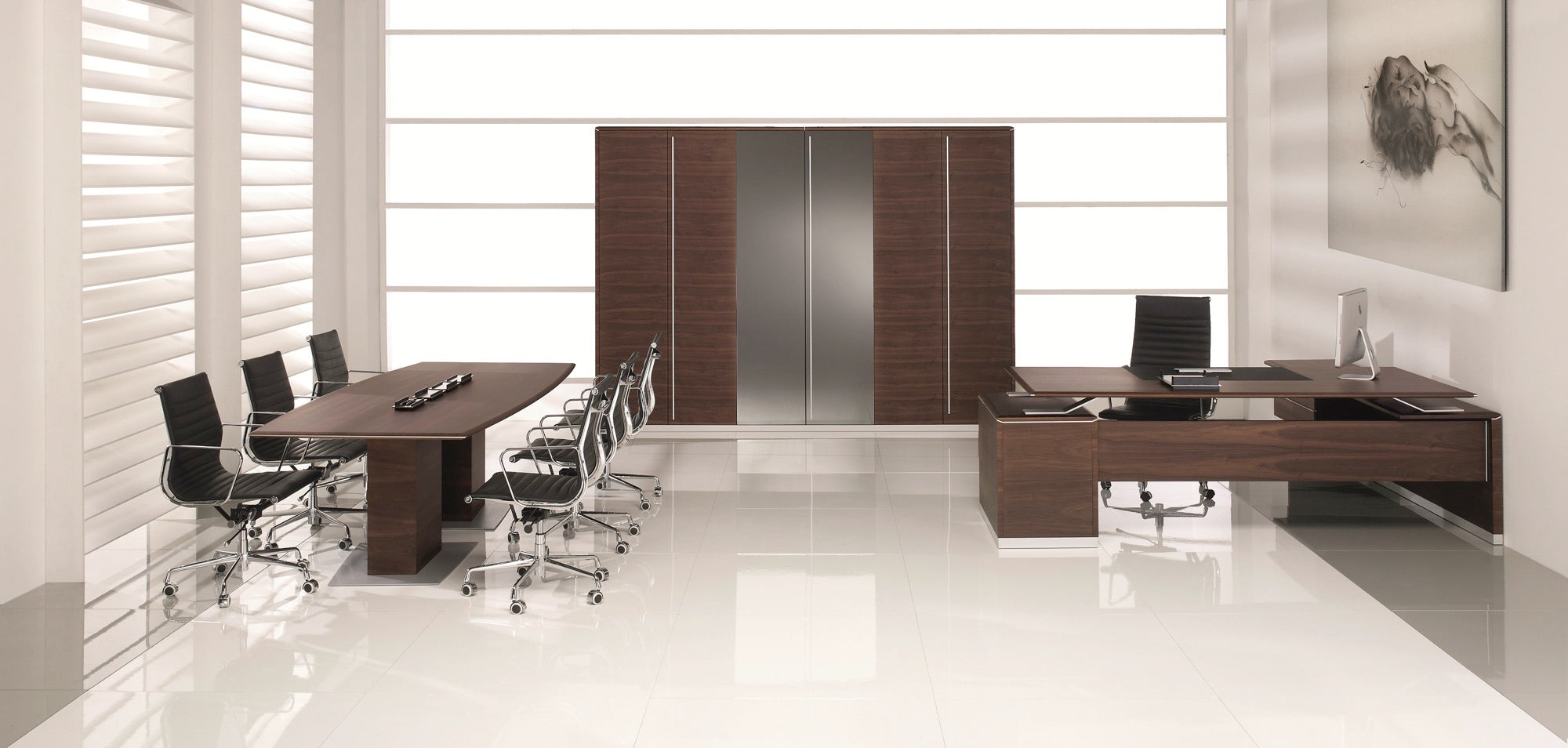
Office furniture for a modern office covers five basic groups: ergonomic chairs, work desks (including sit-stand desks), cabinets and pedestals for storage, acoustic solutions, and equipment for shared spaces such as meeting rooms and reception. A well-furnished office is not just the sum of its furniture pieces, but a thoughtful system that supports healthy posture, concentration and the productivity of employees. This guide explains what you need, how to plan the layout and budget, which materials to choose, and why one partner from consulting to installation pays off for companies.
Which office furniture you need
When furnishing an office, we start from how people actually work. Every workstation needs a chair and a desk, while the space needs a storage system, noise control and areas for collaboration. Below are the main categories that make up complete office equipment.
- Office chairs are the first and most important piece. For workstations we recommend ergonomic office chairs with adjustable height, lumbar support and armrests. For children and teenagers there are children's ergonomic chairs.
- Work desks are the foundation of every workstation. Increasingly these are sit-stand desks that allow you to alternate between working while seated and standing.
- Cabinets and pedestals keep things tidy and provide archiving and personal under-desk drawers (mobile pedestals, wall cabinets, wardrobe cabinets).
- Acoustics reduce noise in open-plan offices with the help of acoustic panels and dividers, which improves concentration.
- Meeting room equipment includes conference tables and conference chairs for meetings and presentations.
- Reception and waiting areas create the first impression; this is where reception desks and chairs for waiting rooms and halls come in handy.
- Break areas and informal gatherings call for comfortable lounge seating that gives people a chance to take a break and have a relaxed conversation.
On larger projects it makes sense to order everything from a single supplier so that materials, colours and style match. You will find the full range in the office furniture collection.
Workstation ergonomics: why it is the foundation
Ergonomics is the starting point, not an add-on. Employees doing office work spend most of the day at their desk, so furniture has a direct impact on their well-being and efficiency. A properly adjusted chair and desk support correct posture and reduce strain during prolonged sitting.
The basic rules of an ergonomic workstation:
- Chair: feet flat on the floor, knees at roughly a 90-degree angle, lumbar support following the curve of the back.
- Desk: a height at which the elbows are at roughly a 90-degree angle; with a sit-stand desk, set it for both sitting and standing.
- Screen: top edge at eye level, at arm's length distance.
- Movement: alternating between sitting and standing throughout the day relieves the body.
An investment in ergonomics pays off for the company indirectly. A comfortable workstation reduces fatigue at the end of the day, helps improve focus, and sends employees a clear message that the company cares about their well-being. When furnishing, we therefore recommend treating ergonomics not as a cost, but as part of the work environment that affects everyday efficiency.
Read more about the proper setup of equipment in the guide how to sit correctly at the computer. If you are choosing a chair, the guide how to choose an office chair will help you.
How to plan the office layout
You plan the office layout based on the number of employees, the way of working and the available floor area. First determine how many workstations you need, how much space collaboration requires, and where quiet zones for focused work are needed.
A practical planning process:
- Measuring the space: floor plan, windows, doors, power and network connections.
- Zones: separate workstations, meeting rooms, break areas and reception.
- Walkways: provide enough room for safe movement between desks.
- Noise and light: place quiet zones and acoustics away from the busiest parts.
- Growth: leave a reserve for new workstations.
When arranging workstations, also take natural light and views into account. Desks beside windows with side light reduce glare on screens, while shared and noisier zones should be placed in the central part of the space so they do not disturb focused work. A modern approach also envisions a mix of fixed workstations and shared desks for hybrid work, which frees up space for collaboration for the same number of employees.
When furnishing larger offices, we recommend professional consulting and a 2D/3D design of the space, so that before ordering you can see how the office will look and function.
How to plan a budget for office furniture
You plan an office furniture budget per workstation, then add the shared spaces. As a guideline, budget for a chair, a desk and basic storage per person, and account separately for meeting rooms, reception and acoustics. The table below shows approximate price ranges by category.
| Category | Price range (indicative) | For whom |
|---|---|---|
| Ergonomic office chair | from about 200 EUR | everyday workstation |
| Sit-stand desk | from about 400 EUR | working while sitting and standing |
| Pedestal / cabinet | from about 150 EUR | storage, tidiness |
| Conference chair | from about 120 EUR | meeting rooms, meetings |
| Acoustic panel / divider | from about 100 EUR | open-plan offices |
When planning a budget, it pays to think in terms of the furniture's entire lifespan, not just the initial price. A quality ergonomic chair with a longer warranty and the option of repair is often cheaper over a few years than a cheap chair that soon needs replacing. On larger projects, also budget a reserve for possible expansion, so that a later top-up purchase matches the existing style.
Prices are indicative and depend on materials, fabrics and the scope of the project. On larger orders, the price per workstation usually drops. You will find a detailed overview of chair prices in the guide how much an office chair costs.
Which materials and fabrics are suitable for an office
The choice of materials affects the look, durability and comfort of the office. For work chairs and furniture in constant use, resistance to wear is key, while in representative spaces the aesthetics and type of material come more to the fore.
- Mesh fabrics allow good airflow and are suitable for chairs that are in use all day.
- Upholstered fabrics give a warmer look and comfort; choose those with high abrasion resistance.
- Leather and faux leather are suitable for executive and representative spaces and are easy to clean.
- Desk worktops in laminate are durable and practical, while veneer gives a more prestigious look.
When choosing fabrics, also consider cleaning and maintenance. For high-traffic spaces such as waiting rooms and meeting rooms, choose materials that can withstand frequent use and can be easily refreshed.
Chairs and desks: the heart of every office
The chair and desk are the pieces employees use all day, so they are the most important investment. With chairs, the choice ranges from standard work chairs to active ergonomic chairs, executive chairs and heavy-duty chairs for a longer working day and heavier users.
With desks, the decision is often between a classic writing desk and a sit-stand desk. The difference lies in the option of working while standing, which encourages movement throughout the day.
When choosing a desk, let the guide how to choose a sit-stand desk help you, and the benefits of working while standing are described in the guide why working while standing is beneficial.
Custom manufacturing for companies
For companies, custom manufacturing is often more sensible than standard solutions, since the furniture is tailored to the space, the brand and the way of working. As a Slovenian manufacturer with our own production in Medvode and more than 40 years of experience, we adapt dimensions, materials, fabrics and colours.
- Fabrics and colours are matched to your corporate identity.
- Dimensions and modules are adapted to the floor plan of the space.
- Logos on seats or dividers for a unified look.
- Consistency across all workstations and shared spaces.
A custom product also means a 3-year warranty and reliable delivery, because we make the furniture ourselves.
Why one partner from consulting to installation
One partner for the entire project reduces risks, saves time and ensures a unified result. Instead of coordinating multiple suppliers, you get a single point of contact for consulting, planning, manufacturing, delivery and installation.
The advantages of a single supplier:
- Unified design: materials, colours and style match across the entire project.
- Less coordination: one project manager from start to handover.
- Reliable delivery: our own production and our own delivery and installation.
- References: we have furnished projects such as NLB (more than 1,200 workstations), Triglav and Volvo.
This approach is especially valuable on larger, phased projects, where everything must work together from day one.
Frequently asked questions
Which office furniture is essential for a new office?
Every workstation needs an ergonomic chair and a desk, while the space needs storage (cabinets, pedestals) and solutions for noise. In larger offices, add equipment for meeting rooms, reception and waiting areas.
How much does furnishing an office cost?
You plan the cost per workstation: a chair from about 200 EUR, a sit-stand desk from about 400 EUR, and storage from about 150 EUR. On larger orders the price per workstation usually drops, so we recommend an individual quote.
Is it better to choose a sit-stand desk or a regular desk?
A sit-stand desk allows working while sitting and standing and encourages movement throughout the day, which is beneficial during prolonged sitting. A regular writing desk is cheaper and suitable when working while standing is not a priority.
How should I plan the layout of an open-plan office?
Start from the number of workstations and the ways of working, then divide the space into work zones, quiet zones, meeting rooms and a break area. In open-plan offices, acoustic panels and dividers reduce noise and improve concentration.
Do you make custom office furniture for companies?
Yes. As a Slovenian manufacturer with our own production, we adapt dimensions, materials, fabrics and colours to the company's needs and brand. A custom product comes with a 3-year warranty and reliable delivery from our own production.
Why choose one partner for the entire office fit-out?
One partner means a single point of contact for consulting, planning, manufacturing, delivery and installation, which reduces risks and ensures a unified look. Our experience is confirmed by references such as NLB, Triglav and Volvo.
Start furnishing your office
Let us help you furnish your office, from the first sketch to the last piece of furniture. At Heka Interior you get consulting, planning, custom manufacturing and our own delivery and installation in one place. Explore the office furniture collection and our selected ergonomic office chairs, and before deciding you can try out a chair free of charge as part of our 7-day free trial. For a project quote, contact us and we will plan your office together.

Share:
How to choose an office chair for a home office
Electric Standing Desk: 2026 Buying Guide