
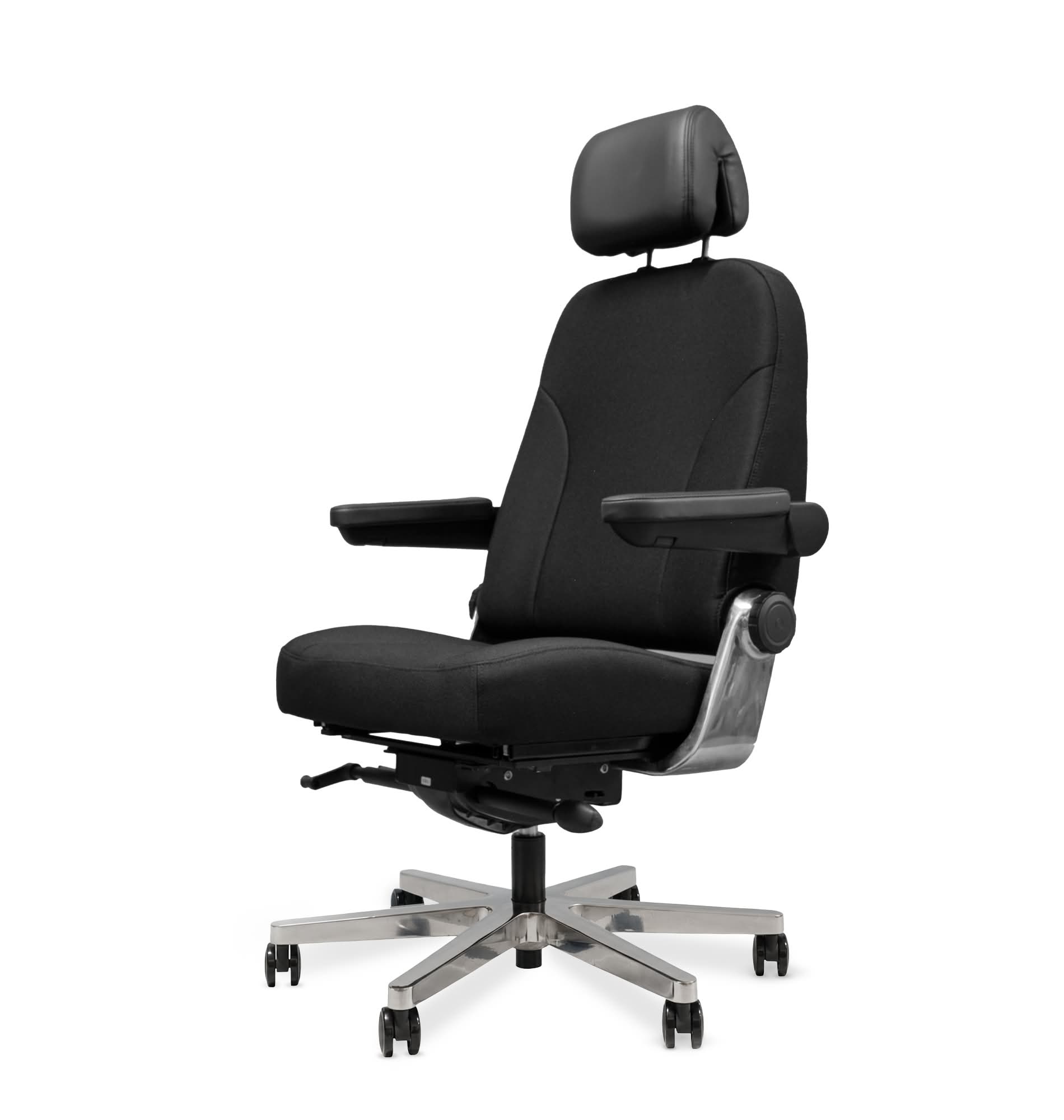
An office chair for higher loads is a chair with a reinforced structure and a higher weight capacity, designed for heavier users and workplaces with continuous operation. As a rule, it supports a weight of more than approx. 120 kg, while the strongest models go up to around 150 kg or more. It differs from a standard office chair through its steel base, a higher-capacity gas lift, a wider and deeper seat, and more durable mechanics that withstand prolonged and multi-shift use.
At Heka, we manufacture such chairs in Slovenia (Medvode, 40+ years of experience). In this guide, we explain what higher loads mean, which elements to look out for when choosing, and who chairs for continuous 24/7 use are suitable for. If you are choosing for the first time, we also recommend the general guide on how to choose an office chair.
When do we speak of higher loads
The term higher loads refers to two factors: the user's weight and the duration of continuous use. A standard office chair is typically tested for a user of up to approx. 110 kg and for a regular 8-hour working day. A chair for heavier users, or a chair with a high weight capacity, is designed for greater stress on the mechanics, the seat, and the base.
Weight capacity is expressed in kilograms. When choosing, it makes sense to allow for a certain margin: if the user weighs close to the chair's upper limit, choose a model with a higher declared weight capacity. This way, the mechanics do not wear out at the edge of their capability, which extends the chair's service life.
Durability is also affected by the pace of use. An ordinary chair withstands a few thousand raises and lowers of the mechanism over its service life, whereas a chair for continuous operation must withstand significantly more. That is why two properties are key for these chairs at the same time: a sufficiently high weight capacity and mechanics tested for more frequent cycles.
- Weight capacity – the most important figure; choose with a margin relative to the user's weight.
- Duration of use – whether the chair will be in use for 8 hours or continuously (24/7).
- User dimensions – a wider and deeper seat for a larger build.
Weight capacity classes and who they suit
The table below shows approximate weight capacity classes and typical use. The values are general guidelines to make choosing easier; the specific weight capacity is always stated for each individual model.
| Weight capacity class | Approximate user weight | Typical use |
|---|---|---|
| Standard chair | up to approx. 110 kg | ordinary office work, 8-hour working day |
| Reinforced chair (higher loads) | approx. 120–150 kg | heavier users, longer working days |
| High weight capacity chair | around 150 kg or more | heaviest users, demanding loads |
| 24/7 chair | depends on the model | continuous operation, multi-shift work |
Ergonomic chairs with adjustable settings are the foundation of any choice – you can find out more about them in the ergonomic office chairs collection. For higher loads, check the dedicated chairs for higher loads collection.
Key elements of a reinforced chair
A chair for a high weight capacity is not merely an enlarged version of an ordinary chair. The difference lies in the materials and construction, which must withstand greater and more frequent stress. Every load-bearing part is dimensioned so that it withstands the anticipated weight with a margin.
- Reinforced construction – stronger load-bearing elements and connections that do not give way under greater weight.
- Metal or steel base – instead of plastic; a steel star base withstands significantly greater loads.
- High-quality gas lift – a powerful gas cylinder tested for more frequent lifting and greater weight.
- Wider and deeper seat – more space and better pressure distribution for a larger build.
- Durable mechanics – a reinforced synchronous or multifunctional mechanism with a stronger spring.
- Durable fabrics – abrasion-resistant fabrics or leather that withstand intensive use.
- High-capacity castors – castors with a higher load rating for stable movement.
These elements directly affect how long the chair supports proper posture and relieves the spine even during prolonged sitting. If you are interested in sitting while in pain, read the guide on the best office chair for back pain.
Who is a chair for higher loads suitable for
A chair for higher loads makes sense anywhere an ordinary chair could not withstand the weight or pace of use.
- Heavier users who need a higher weight capacity and a wider seat for comfort.
- Workplaces with continuous operation – dispatch and control centres, security services, call centres.
- Multi-shift work, where the same chair is used by several people across different shifts (so-called 24/7 chairs).
- Executive and representative spaces, where you want a high-capacity and elegant chair; take a look at the executive chairs.
At Heka, for these needs we manufacture the Titan 24/7 and Stratos XL models – both are designed for demanding loads and prolonged use.
What to watch out for when buying
Before deciding, check a few key points so that you choose a chair that will withstand the anticipated load.
- Declared weight capacity – always check the figure and choose with a margin.
- Base material – for higher loads, give preference to a steel base.
- Adjustment options – adjustable height, armrests, tilt, and lumbar support.
- Warranty – a longer warranty is an indicator of the manufacturer's confidence in durability.
- Trial before purchase – test the chair in real conditions, not just for a few minutes.
It is also sensible to think about your budget in advance; we explain the approximate price ranges in the guide on how much an office chair costs. At Heka, chairs for higher loads are available from approx. 350 EUR upwards, depending on the model, fabric, and equipment.
A chair for higher loads compared with an ordinary chair
There are several differences between a reinforced and a standard office chair that are not visible at first glance, yet significantly affect durability and comfort during prolonged sitting.
| Property | Standard chair | Chair for higher loads |
|---|---|---|
| Weight capacity | up to approx. 110 kg | over 120 kg, up to around 150 kg or more |
| Base | plastic or metal | steel, reinforced star base |
| Gas lift | standard | high-capacity, for more frequent cycles |
| Seat | standard width and depth | wider and deeper |
| Mechanics | ordinary synchronous | reinforced, stronger spring |
| Typical use | 8-hour working day | also continuous 24/7 use |
For users who spend most of the day at a desk, a reinforced chair is often the better investment simply because of its longer service life. A more robust construction means less wear, which pays off in the long run. If you are comparing ergonomic and ordinary chairs in general, it is good to understand what ergonomics actually brings – it is also the foundation of chairs for higher loads.
How to test a chair before buying
A chair for higher loads cannot really be assessed in a few minutes in a showroom. You get the true picture only after a few days of regular use in your own working environment, when you load the chair the way you will every day.
- Use the chair for at least a few days for a full working day, not just a few minutes.
- Check whether all the settings are accessible and hold under your weight.
- Pay attention to the stability of the base and the quiet, smooth operation of the mechanics.
- Assess the width and depth of the seat relative to your build.
That is precisely why, at Heka, we offer a 7-day free trial. This way, you decide on a chair based on experience and not just on technical data on paper.
Warranty, durability, and comfort
Durability is essential for chairs for higher loads, as they are exposed to greater and more frequent stress. We manufacture Heka chairs in Slovenia and provide a 3-year warranty for them. Every chair can be made to measure – with a choice of fabric, frame colour, and additional equipment.
Comfort during prolonged sitting is not only a matter of a soft seat. What matters is the combination of an appropriate weight capacity, the right seat size, and adjustable ergonomics that support proper posture throughout the working day. Our solution includes our own delivery and assembly, and the chairs are also trusted by NLB (1,200+ workstations), Triglav, and Volvo.
Frequently asked questions
What should the weight capacity of an office chair for higher loads be?
For heavier users, choose a chair with a declared weight capacity of more than approx. 120 kg, and for the heaviest users around 150 kg or more. Always allow for a margin relative to the user's weight, so that the mechanics do not operate at the edge of their capability.
What is a 24/7 office chair?
It is a chair designed for continuous operation – for example in dispatch and control centres, security services, or in multi-shift work. It has a reinforced construction, high-capacity mechanics, and durable materials that withstand use throughout the day and night.
Is a chair for higher loads also suitable for ordinary office work?
Yes. A reinforced chair is perfectly usable for ordinary office work too and often offers even more comfort thanks to its wider seat and more robust construction. It is, however, generally somewhat more expensive than a standard model.
Which materials does a good high weight capacity chair have?
Look for a steel or metal base, a high-quality gas lift, a reinforced mechanism, and abrasion-resistant fabrics or leather. These elements ensure that the chair withstands greater weight and more frequent use without giving way.
Order a chair for higher loads from Heka
Are you looking for an office chair for higher loads that will withstand the weight and pace of your work? Take a look at the chairs for higher loads collection and choose among Slovenian models with a reinforced construction and a 3-year warranty. Before buying, take advantage of the 7-day free trial – test the chair in your own working environment and decide based on experience.


Share:
Conference Chairs for Meeting Rooms: A Guide for Businesses
Children's Ergonomic Chair: How to Choose for a Schoolchild